
See these pews right up here in the front? Years ago, they might have looked a bit different than these we have today. I didn’t reserve them for a special purpose today, but I thought about it! In the early Methodist revivals, there were no nice, cushioned altar rails to come and kneel for prayer. Instead, there was a simple wooden bench near the front of the worship space called the “mourner’s bench” or sometimes the “anxious bench” – where people were invited to come and sit to mourn their sins and contemplate their need for repentance and forgiveness.[1] It was a pivotal feature of 19th century American revivalism, and it echoed back to the Wesleyan revival of the 18th century, with what was often referred to as the “mourner’s rail.”
Here is how it worked. Once worship and preaching had begun, those feeling convicted in the worship service would get up and move to this front bench, publicly displaying their spiritual need and also allowing others to pray for them directly. So … while I am preaching, just wanted to make clear you can come on up! Any takers? In all seriousness, that is why I love the weekly altar calls that we have here at Edenton Street UMC, which feels like the best of Word and Table liturgy. Every week there is an invitation to come to the table and come to the altar, to pray, to commit, to receive, and to be sent forth.
Why did I begin there this morning?The preaching task is something I have been reflecting on deeply this week. What is a sermon supposed to do? What is a sermon supposed to make us feel? How is a sermon different from a TedTalk, a lecture, a poetry slam, a literature reading, spoken word, or a political stump speech?
Any sermon worth its salt can only answer such questions by going to the book – or should I say – the books – all 66 of them in Holy Scripture found in your bibles. I hope you will get into the habit of bringing your bible with you to worship, though we also have them in the pews for you as well. And … and this may be hard for us to hear – if a sermon is truly biblically based and in the long-standing tradition of both the Hebrew scriptures and the New Testament – these moments of proclamation should probably come with a clear warning label: “Continue listening at your own risk. What follows may well afflict the comfortable and comfort the afflicted. In other settings, you may hear words like ‘sit back, relax, and enjoy the ride’ – not here, not today, and if we are to take Jesus seriously – not ever.”
What is a sermon to do? In my estimation as a Christian and a preacher, it should always proclaim Good News. But good news does not always mean easy news or unchallenging news, or news that leaves us alone to do life as we see fit, without a call to be changed, challenged, and transformed by the renewing of our minds. God’s word read and proclaimed can and does bring comfort – and it should. But it is equally true that God’s word faithfully read and proclaimed can evoke us to feel anxious (anxious bench), uncomfortable, awkward, sad, mournful (mourner’s bench), and even fearful about how our lives, actions, and words might be viewed by God and in light of God’s word, God’s justice and God’s judgment.
If you are feeling a bit anxious right about now, then just know that you are in good company! Sermons can be dangerous.
Take the sermon in Isaiah 6, where the prophet Isaiah begins with uncompromising words: “God said, ‘Go and say to this people: Listen intently, but don’t understand; look carefully, but don’t comprehend.’”[2] Awkward, right? Take the prophet Ezekiel who was commissioned to go preach with these words: “I’m sending you to the Israelites, a traitorous and rebellious people … whether they listen or whether they refuse … well … they will know that a prophet has been among them.”[3] In John’s Gospel, Jesus preaches about his body being bread and his flesh being food, and instead of the congregation greeting him on the way out with “good job, Jesus” he hears from some of his own followers: “this message is harsh. Who can hear it?”[4]
Sermons should come with warning labels – for the listener and also for the preacher. How does the preacher in Hebrews put it? God’s word is living, active, and sharper than any two-edged sword. It penetrates to the point that it separates the soul from the spirit and the joints from the marrow. It’s able to judge the heart’s thoughts and intentions. No creature s hidden from it, but rather everything is naked and exposed to the eyes of the one to whom we must give an answer.[5] Can a sermon make us feel anxious? Fearful? Yes. Especially if we feel like our words, our actions and our lives out not in alignment with God’s word. Especially when God’s word exposes how we are not living in compliance with the faith we profess.
So with all of that context for both the sermon and the preacher – today we get an clear view of the premier preacher among all other preachers. Today I will call him the first and the last preacher – and I would call his sermon – all of it – the beginning of the sermon, the end of the sermon, and the middle of the sermon as the sermon from which perhaps all other sermons should be judged. And today, we hear this inaugural sermon, the first of many in Luke’s Gospel, preached in a Nazarene synagogue to a home-town crowd at a home-coming service. Some called him Jesus, some only knew him as Joseph’s son, others would later discover he was Son of God, the Good Shepherd, the Living Water, the Paschal Lamb, the Final Sacrifice, and the long-awaited Messiah. Today, I will just call him – Preacher.
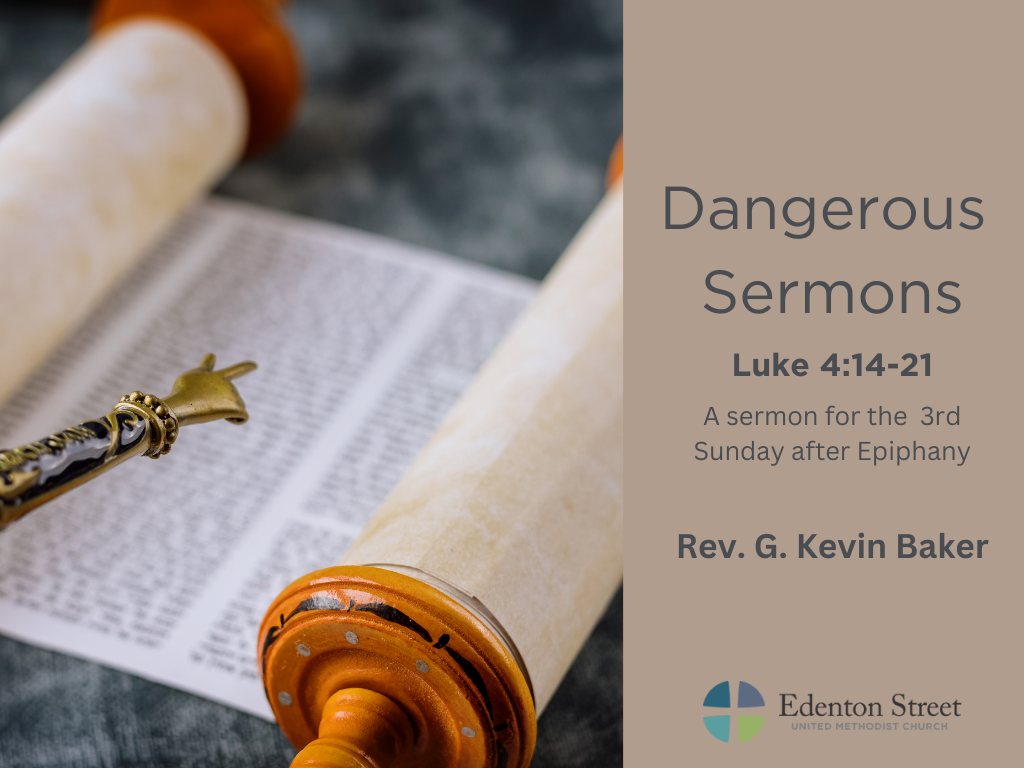
He went to synagogue that day, as was his custom, and stood up to read. The scroll of the prophet Isaiah was given to him. He unrolled the scroll, selected his homiletical text for the day, and read these words: The Spirit of the Lord is upon me, because he has anointed me to bring good news to the poor. He has sent me to proclaim release to the captives and recovery of sight to the blind, to let the oppressed go free, to proclaim the year of the Lord’s favor.”
And he rolled up the scroll, gave it back to the attendant, and sat down. There was a hush over the congregation. The eyes of all in the synagogue were fixed on him. But the sermon wasn’t over: Today this scripture has been fulfilled in your hearing. That is where our reading this morning stops, right there … but that is precisely where the sermon starts to get interesting, because this preacher is not finished. He has not yet fully expounded on the text. He has yet to “break it down,” “make it plain” and “bring it home.” Preacher Jesus was the first to do what we often refer to as “toe steppin’” exhortation. What follows is a sermon to end all sermons. This preacher is not just interested in revival, he is calling for revolution.
Jesus took the word “poor’ and gave it a face, a story, and a name. Remember, said preacher Jesus, how God cared for a foreign widow in Zarephath in Sidon, even when a famine was raging on the home front with plenty of other hometown folks and widows were also in need? Remember, said preacher Jesus, how God cleansed a foreign leper from Syria when there were plenty of lepers right next door in every village and town of Israel – but none of them were cleansed? I assure you that no prophet is welcome in the prophet’s hometown.
This inaugural sermon of preacher Jesus sets the tone and framework for everything else that follows in Luke’s gospel. This is Jesus saying: “I don’t just want to save you from your sins, I want to save you from yourselves – your petty preoccupations, your pride, your self-righteousness, your one-upmanship, your desire to be first in line rather than servant of all.” This is Jesus, filled by the Spirit, baptized in the Spirit, and anointed by the Spirit – inviting us to be filled with the Spirit, empowered by the Spirit, freed by the Spirit to walk in newness of life and love. And – let me also remind us all that at the end of this rousing sermon by preacher Jesus, there was no greeting and handshake, or “see you next Sunday” pleasantries on the way out of worship – what came next was anger, fear, and group think emotions that led the crowd to try and throw Jesus literally off the nearest cliff. (I often share this story with anyone who says they are called to ordained ministry and the task of preaching – I direct them to reread this story about preaching and then ask them again – are you sure?)
Church – we are standing in a long line of preachers, congregational worshippers, and followers of Jesus who may not always feel comfortable with the soul-piercing, sin exposing, change evoking Word of God for the people of God – but here we are. We find not only these truth-telling messages in Scripture, but also throughout Christian history. If time were no object today, we could expand upon many sermons in our Christian tradition that should have had warning labels attached:
Jonathan Mayhew’s 1750 “Discourse Concerning Unlimited Submission” in Boston’s “Old West Church” that challenged divine right of kings, leading to accusations of sedition from British authorities.
Reverend Nicholas Hoppin’s 1851 sermon against the Fugitive Slave Act in Cambridge, MA led to threats and surveillance from pro-slavery activists.
Martin Niemöller’s 1946 “First They Came…” sermon in Germany acknowledged German Christians’ complicity in Nazi crimes, resulting in death threats and exile from conservative church leadership.
Archbishop Óscar Romero’s final homily in El Salvador (March 23, 1980) condemned military violence against civilians. He was assassinated the next day while celebrating Mass.
Dietrich Bonhoeffer’s 1933 radio sermon “The Führer and the Individual” was cut off mid-broadcast for critiquing the cult of leadership in Nazi Germany.
And I would add The Right Rev. Mariann Edgar Budde’s sermon at the Washington National Cathedral on this past Tuesday, January 21, 2025 in “A Servcie of Prayer for the Nation.” A sermon that was clearly a kind but very honest and unapologetic appeal to unity, mercy, compassion, and justice – despite the many divides and divisions that are so much a part of our families, our cities, our communities, and our nation. Did it make people and leaders feel awkward? Yes. Did it likely produce some anxiety in the listeners? Likely. Was it outside the scope of biblical tradition and Christian preaching throughout history? Not at all. There is a reason that God’s word might make us anxious.
To return to one of those sermons in closing, let me share with you these words from Oscar Romero the day before he was assassinated in worship, literally behind the Lord’s Table.
The day before he proclaimed God’s word and pleaded with leaders to stop the killing. Here is part of that dangerous sermon:
“I know many are shocked by this preaching and want to accuse us of forsaking the Gospel for Politics. But I reject this accusation. … Each week I ask the Lord to give me the right words to console, to denounce, to call for repentance. And even though I may be a voice crying in the desert, I know that the church is making the effort to fulfill its mission … [he then goes on to name the tragic murders of specific people killed by the military that week] … I would like to make a special appeal to the men of the army, and specifically to the ranks of the National Guard, the police and the military. Brothers, you come from our own people. You are killing your own brother peasants when any human order to kill must be subordinate to the law of God which says, “Thou shalt not kill.” No soldier is obliged to obey an order contrary to the law of God. … in the name of this suffering people whose cries rise to heaven more loudly each day, I implore you, I beg you, I order you in the name of God: stop the repression. The Church preaches your liberation just as we have studied it in the Holy Bible today. It is a liberation that has, above all else, respect for the dignity of the person, hope for humanity’s common good, and the transcendence that looks before all to God and only from God derives its hope and its strength.”
So today, I stand in the awesome and humbling line of preachers …and I point, like them, to one who is greater than I. Jesus’ sermon today calls us to join him in his continuing mission from God: to bring good news to the poor in his name, whether they live in Raleigh, Gaza, Israel, the still hurricane-devastated mountains of N.C. or the burnt-over communities of California hillsides. Jesus invites us to share in the proclamation of release to the captives, whether that means those in prison, those bound by addiction, those enslaved by debt, or those held captive to sin. Jesus exhorts us to join him in his healing ministry of resorting sight to the blind, whether that be people blinded to spiritual truth or physical beauty – and that includes asking God to help us all be sighted enough to spiritually see the plight of marginalized communities in our midst – the immigrant, our LBGTQ brothers and sisters, and all who are fearful about their lives, their futures, their status, and whether or not they are truly welcome among us, among our communities, and in our churches. As followers of Jesus, we must proclaim – ALL ARE WELCOME – NO EXCEPTIONS. Jesus – our RABBI and PREACHER is inviting us not just to a revival where we can come to the altar and leave a changed person, he invites us to a revolution of love where the whole world can come to Jesus and leave as a new creation. I want to respond to that altar call! I hope you do too. Amen.
[1] Mark Shenise, the United Methodist General Comission on Archives and History, in online article titled “Methodist History: The Mourner’s Bench,” as quoted at umc.org and accessed on March 9, 2018 at http://www.umc.org/what-we-believe/methodist-history-the-mourners-bench
[2] Isaiah 6:9-10
[3] Ezekiel 2:3-5
[4] John 6:60
[5] Hebrews 4:12

 gkevinbaker.com