
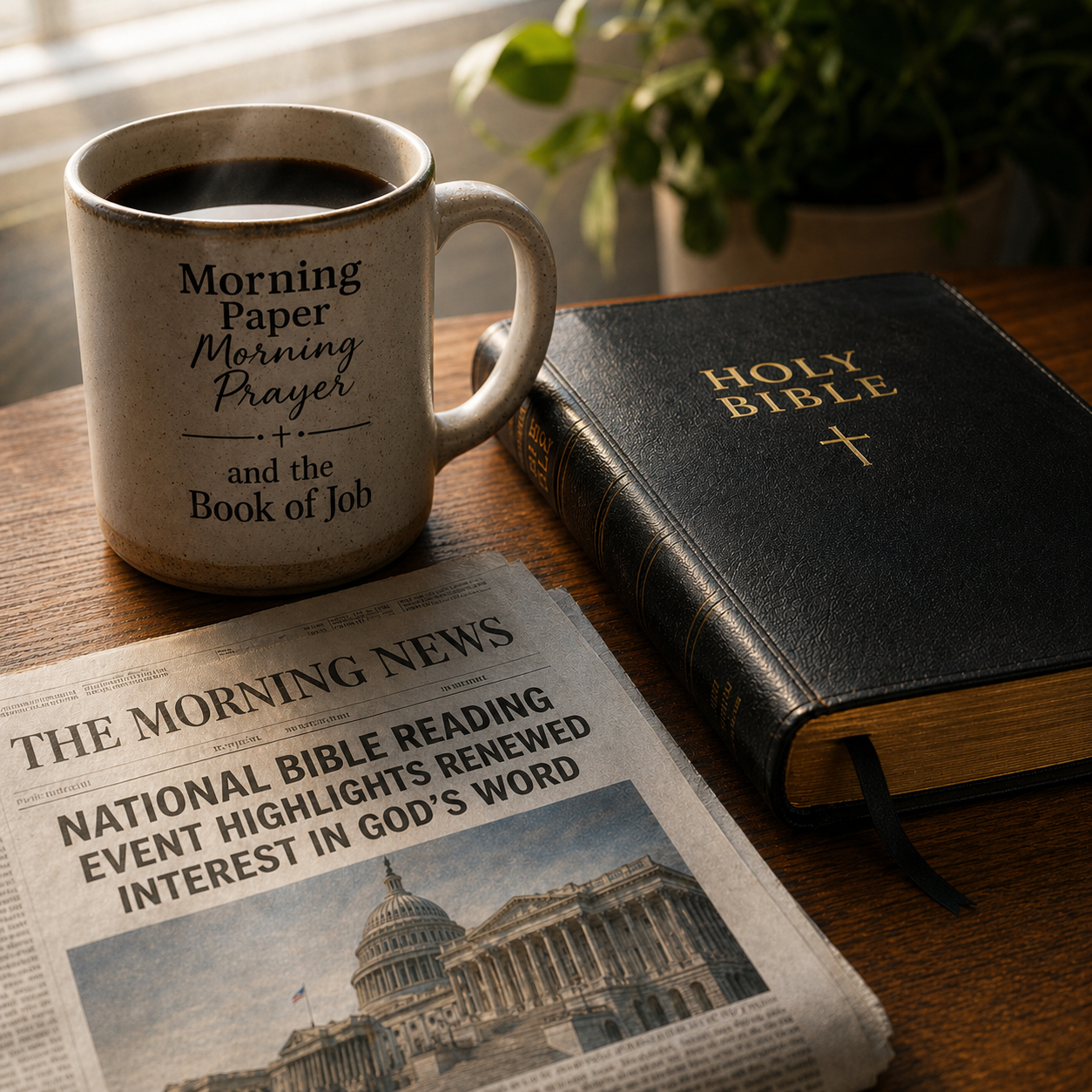
This morning, I did what I often do before opening Scripture for my daily reading: I read the newspaper. One of those headlines included coverage of a week-long public Bible reading at the Museum of the Bible in Washington, where politicians and celebrities are taking turns reading the Bible aloud in what is being framed as a national renewal of interest in God’s Word. I sat with that for a moment before turning to today’s reading for April 25th in our congregation’s Bible-in-a-Year journey: Job, chapters one through five. The dissonance for me was immediate and instructive.
Job is one of the most theologically daring books in the entire canon, and I have loved it for exactly that reason for most of my adult life. It sits inside our Scripture as a deliberate counter-voice to Deuteronomic theology, the tidy system of blessings for the obedient and curses for the wayward that those reading with us may recall from the chapters near the end of Deuteronomy, and honestly threaded through many other texts we have already read together this year.
The book of Job will not let that framework stand unchallenged. His friends, Eliphaz, Bildad, and Zophar are not villains – they are sincere, biblically literate people who genuinely believe they are reading their tradition correctly. And, to put it bluntly, they are wrong. The Book of Job is in the canon precisely to remind us that even our most confident theological explanations can become weapons against the suffering, and that God is not a vending machine that rewards the righteous and punishes the wicked on a predictable schedule. No one can read Job faithfully and walk away with simple answers. What we can do is walk away with better questions and a deeper reverence for the mystery of God.
This is why I find myself unsettled by what is happening in Washington. I want to be careful here, because I genuinely celebrate anyone who picks up Scripture, and I have devoted my life to the conviction that the Bible is the Word of God. But there is a category mistake being made that concerns me deeply, and it is not a new one; it goes back at least to Gutenberg (the inventor of the printing press around 1450), when Scripture first became something an individual could own rather than something a community heard together.
The “America Reads Bible” event motto is “one week, one nation, one book.” I understand the sentiment, but it is precisely this kind of marketing that exposes the problem. It is not one book, it is sixty-six, a library spanning centuries, genres, languages, and communities. And sixty-six is itself an interpretive choice: our Catholic sisters and brothers read seventy-three. Our Jewish neighbors, whose scriptures we have received as our own Old Testament, read and organize those same texts differently still. None of those differences fell from the sky. They were discerned and settled, and are still being lived out by communities of faith – in council and conflict, over centuries of prayer and argument.
In other words, the very shape of the Bible we hold is a product of exactly the kind of communal, prayerful, contested discernment the events like this cannot hold or understand. The canon is a gift from the Church – carried to us by communities who I believe were led by the Holy Spirit, but also whose very human fingerprints are on every page nonetheless.
At the top of the “America Reads Bible” website for this week, there is the video of the President featured prominently on the homepage. A click away is a page of readers, many of whom are politicians and celebrities, all from mainly one partisan, political side of the aisle. This also does something very specific to the text being read. It does not simply read the Bible; it recruits the Bible. It suggests that the primary interpretive community is not the Body of Christ but the nation, or more precisely, one political vision of the nation. That does not signal to me the renewal of Scripture. That is a replacement of the Church with the state as the Bible’s proper home.
Scripture was written by communities of faith, shaped and canonized by communities of faith, and has always been intended to be read, wrestled with, and lived within communities of faith. Jesus himself interpreted Scripture to the disciples on the Emmaus road, and it was precisely that interpretive journey together that prepared them to recognize him in the breaking of bread.
Jesus regularly went to the synagogue to read and discuss and dispute. Stanley Hauerwas made this point provocatively in Unleashing the Scripture: Freeing the Bible from Captivity to America years ago: the Bible is not a text that belongs to any individual reader or any nation. It belongs to the Body of Christ, and to our elder siblings the Jewish people, who have been wrestling with Torah, Nevi’im, and Ketuvim in exactly this communal, embodied way for millennia.
That is why I am so glad that the ESUMC church family is reading the Bible together, in communion. Tonight, somewhere between nine and ten o’clock, the Washington event concludes with the final chapters of Revelation. One week done. Meanwhile, back in Raleigh at ESUMC, I want to encourage all of us to keep reading. We will continue our journey with Job through the end of April, wrestling with human suffering, listening to his friends confidently explain what they cannot possibly understand, and cultivating curiosity about presence that shows up amidst the pain.
In May we turn to Scripture’s original book of common prayer, the Psalms, which might also be considered Scriptures first hymn book. We will pray them, argue with them, sing them, and be opened up by them, together, as fellow sojourners on the way. Later in May and into June, we will also be offering a sermon series from parts of the psalter near the end of our shared readings and study of this amazing book of poems.
The truth is, I am always genuinely happy when people read the Bible. But my deeper hope … the thing I find myself praying for earnestly is that everyone who picked up Scripture this week might find their way to a faithful, praying, worshipping community where they can keep doing so in ways that are less performative and more transformative. That they might discover people who will walk alongside them next week, and the week after that. Who will correct them and encourage them and be corrected by them in return. Not seven days out of a year. Not even just one hour on Sunday mornings. But daily … a people formed by shared baptismal vows, nourished by the same table, bound to God and to one another, committed to being not just readers of the Word but bearers of the life it witnesses to in Jesus.
Reading scripture is one thing. Allowing it to read us … and judge and correct and exhort and shape us – well that is another. That kind of reading changes you. And changed people, gathered in humble communities of faith scattered in every city, county, culture and nation is what this world truly needs.


